Why human heart beats on its own
It’s the 1780s in Italy, in the laboratory of Luigi Galvani. He discovered that when he touched a metal object to thel leg of a dead frog, the leg twitched. Dead muscle had moved. He called this “animal electricity”. People at the time laughed at him. How could something dead move?
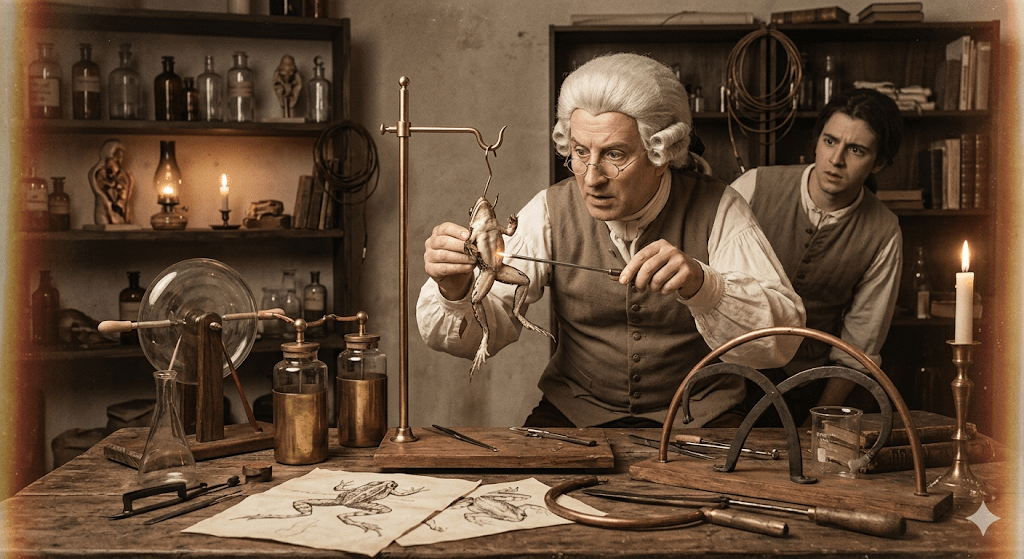
But Galvani was right. And here is a more shocking fact : If you take a frog’s heart out and place it on a dish, it continues to beat for a while, even though it doesn’t look like to have nerves, brain, and is separated from the body.
Key : autonomous

Other muscles waits for a command from the nerves.
: The biceps only curls when the brain commands, “Flex”. Even the diaphragm waits for orders from the medulla. But the heart is different. Heart muscles calls generate electricity on their own. This is called automaticity.
Why did it evolve this way?
Why did nature design the heart like this?
The answer is simple : to eleminate a single point of failure.
If the heart depended on commands from the brain, what would happen? A single stroke would stop the herat. A spinal cord injury would stop the heart. Falling asleep would stop the heart. Evolutionarily, that is a terrible design.
So, nature built a self-contained generator into the heart. Even if the brain dies, the heart keeps beating Even if the nerves are cut, the heart keeps beating.
The heart is its own autonomous little universe. The nervous system merely regulates the speed – acting as the accelerator and the brake.
Where does that “electricity” come from?
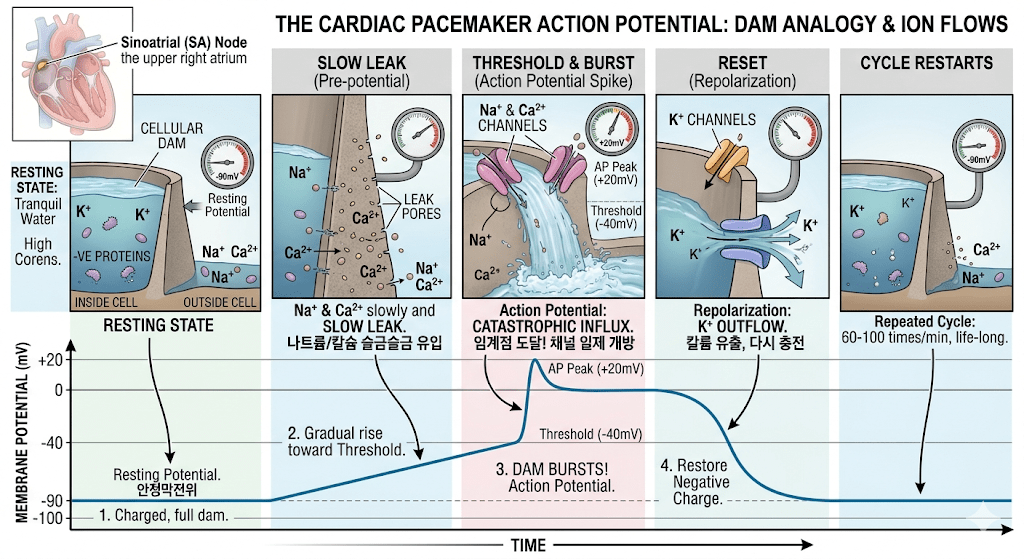
Think of a heart cell as a dam.
Usually, the inside of the dam is full of water while the outside is empty.
Because of the difference in water levels, there is pressure. This pressure is the cell’s voltage.
In a heart cell :
– Inside : plenty of Potassium(K+) and negatively charged proteins
– Outside : plenty of Sodium(Na+) and Calcium(Ca2+)
Normally, the inside of the cell is about -90mV more negative than the outside – like a dam holding back a full reservoir of water. This state is called the resting potential.
Now, here is where the magic happens. A specific group of heart cells – a tiny cluster in upper corner of the right atrium – has “leaky holes” in the dam that open automatically. As time passes, Sodium and Calcium slowly seep inside, and the negative charge inside begins to fade. The voltage rises from -90mV to -80,-70, then -60.
The moment it hits a threshold (about -40mV), the dam bursts. All the Sodium and Calcium channels open at once, and positive ions pour into the cell like a waterfall. The voltage instantly spikes to +20mV. This is single action potential – the start of one single heartbeat.
And what happens after the dam bursts? The cell pushes Potassium back out to recover its negative charge. It refills the dam. Then, it starts leaking again. It reaches the threshold again. It bursts again.
This endless cycle of “Refill-Leak-Burst-Refill” is our heartbeat. 60-100 times a minute. About 3 billion times in a lifetime. Without ever taking a break.


답글 남기기