Biochemical basic
Action potentials are triggered by specialized voltage-gated ion channels in the cell membrane. These channels are membrane-embedded protein complexes characterized by three key properties
1. Multiple conformational states
2. Selective permeability
3. Voltage-dependent transition
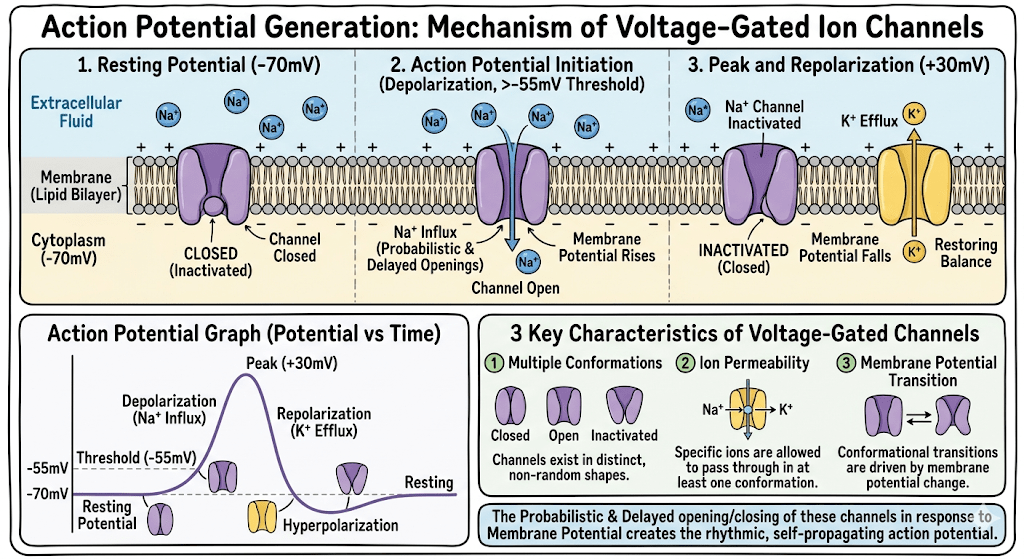
Membrane potential determines the transition rates and the probability of the channel being in a particular conformation at any given unit of time.
Voltage-gated ion channels generate action potentials through a positive feedback loop. Since the membrane potential controls the state of the ion channels, and the ion channels, in turn, control the membrane potential, a rise in potential under certain conditions opens the channels, causing the potential to climb even further.
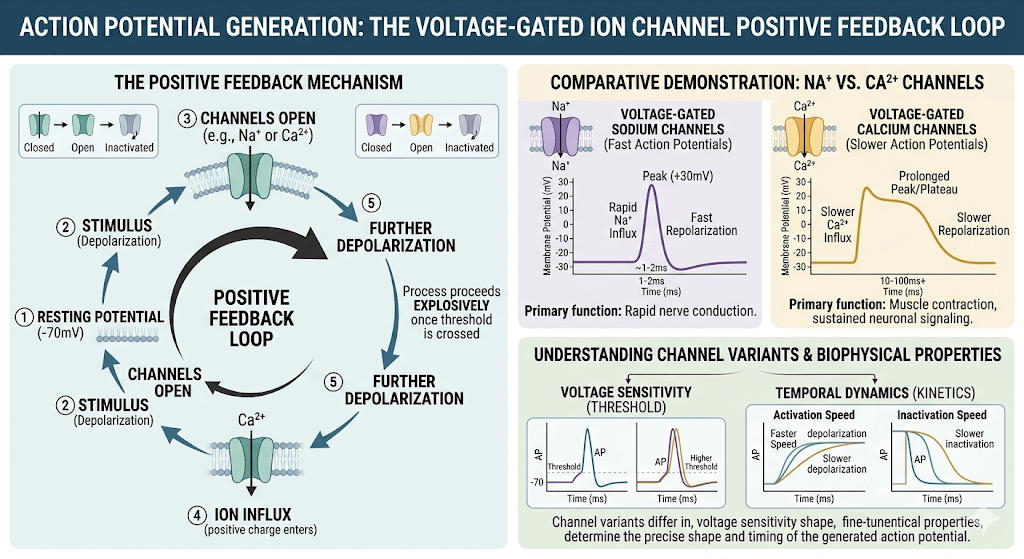
An action potential occurs when this positive feedback cycle proceeds explosively. The trajectory of its timing and magnitude is determined by the biophysical properties of the specific channel involved. Various types of channels serve this positive feedback function
– Voltage gated sodicum channels produce the rapid action potentials associated with nerve conduction
– Voltage gated calcium channels are responsible for the slower action potentials found in muscle cells and certain neurons.


답글 남기기